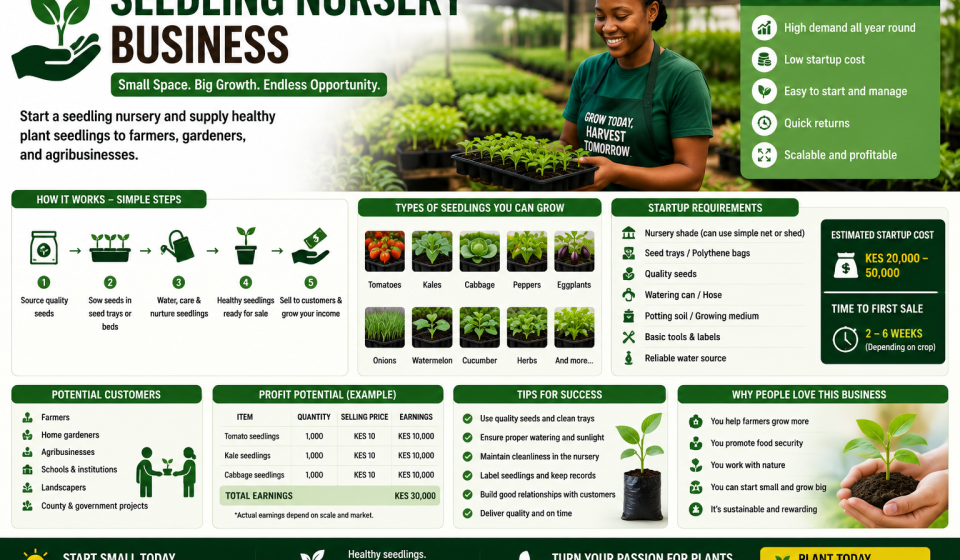
How to Start a Profitable Seedling Nursery Business – A Complete Practical Guide to Building a Fast-Cashflow Agribusiness with Low Capital
When most people think about farming, they think about:
Table Of Content
- Seedling nursery farming.
- A supplier to farmers.
- 1. Faster Returns Than Traditional Farming
- 2–8 weeks
- 2. Low Land Requirement
- 3. Constant Demand
- 4. Lower Farming Risk
- Open Nursery
- Shade Net Nursery
- Greenhouse Nursery
- Main Customer Groups
- 1. Poor Germination
- 2. Water Shortages
- 3. Disease Outbreaks
- 4. Seasonal Demand Fluctuation
- Farmers need healthy starts.
- Large land
- Expensive machinery
- Long waiting periods before harvest
That perception discourages many beginners from entering agribusiness.
But there is a simpler and smarter entry point into agriculture:
Seedling nursery farming.
Instead of waiting months to harvest crops, you grow and sell seedlings to farmers and gardeners who need healthy plants ready for transplanting.
In simple terms:
You supply the starting point of farming.
And because farmers plant continuously, demand for quality seedlings never truly disappears.
This makes a seedling nursery one of the:
- Lowest-capital agribusinesses
- Fastest cash-cycle farming businesses
- Most scalable agricultural side hustles
especially for beginners.
What Is a Seedling Nursery Business?
A seedling nursery business involves:
- Germinating seeds
- Raising young healthy plants
- Selling them before maturity
Instead of growing tomatoes to harvest, for example, you sell the tomato seedlings to farmers.
You become:
A supplier to farmers.
Why This Business Is So Powerful
1. Faster Returns Than Traditional Farming
Traditional farming may take:
- 3–6 months before income
Seedlings can be sold within:
2–8 weeks
This creates faster cash flow.
2. Low Land Requirement
You do not need acres of land.
Many nurseries start successfully in:
- Small backyards
- Small plots
- Greenhouses
- Urban and peri-urban spaces
3. Constant Demand
Farmers continuously need:
- Vegetable seedlings
- Fruit tree seedlings
- Herbs
- Hybrid crop seedlings
Especially during planting seasons.
4. Lower Farming Risk
You avoid:
- Long-term crop diseases
- Large-scale weather risks
- Long waiting periods
Your production cycle is shorter and more manageable.
What Seedlings Can You Sell?
Start with high-demand crops.
Vegetable Seedlings
These are fast-moving and beginner-friendly.
Examples:
- Tomatoes
- Capsicum
- Sukuma wiki
- Cabbage
- Onions
- Spinach
Fruit Tree Seedlings
These often have higher profit margins.
Examples:
- Avocado
- Mango
- Passion fruit
- Tree tomato
- Lemon
Herbs & Specialty Crops
Higher-value niche market.
Examples:
- Rosemary
- Mint
- Coriander
- Basil
Tree Seedlings
Used for:
- Landscaping
- Forestry
- Environmental projects
Examples:
- Cypress
- Grevillea
- Eucalyptus
Why Farmers Prefer Buying Seedlings
Many farmers now prefer buying ready seedlings because:
- Germination is difficult
- Seeds are expensive
- Healthy seedlings improve yields
- It saves time
You are solving those problems for them.
Startup Requirements
The beauty of this business is simplicity.
Basic Requirements
| Item | Purpose | Estimated Cost |
|---|---|---|
| Seed trays/polybags | Germination | KSh 2,000 – 10,000 |
| Seeds | Production | KSh 2,000 – 15,000 |
| Watering can/hose | Irrigation | KSh 1,000 – 5,000 |
| Shade net | Protect seedlings | KSh 5,000 – 20,000 |
| Soil & manure | Growing medium | Variable |
| Small space | Nursery area | Existing backyard possible |
Choosing the Right Location
A good nursery location should have:
- Reliable water supply
- Good sunlight
- Easy accessibility
- Security
- Proper drainage
Avoid:
- Flood-prone areas
- Extremely windy locations
- Areas with poor water access
Understanding the Nursery Setup
Most seedlings require protection during early growth.
Common Nursery Structures
Open Nursery
Simplest setup.
Suitable for:
- Small beginners
- Backyard operations
Shade Net Nursery
Protects seedlings from:
- Excess heat
- Heavy rain
- Strong sunlight
Highly recommended.
Greenhouse Nursery
More advanced and expensive.
Provides:
- Better environmental control
- Higher-quality seedlings
Suitable for scaling later.
Visual Placeholder
📌 Insert image: Organized seedling nursery with healthy green trays under shade net structure
Step-by-Step Guide to Starting
Step 1: Research Market Demand
Before planting:
Find out what farmers actually need.
Visit:
- Agrovet shops
- Farmers
- Markets
- Farming groups
Focus on:
- High-demand crops
- Seasonal demand
- Local farming trends
Step 2: Source Quality Seeds
Seed quality determines:
- Germination rates
- Plant health
- Customer trust
Buy from:
- Certified seed companies
- Reputable agrovet suppliers
Avoid fake or poor-quality seeds.
Step 3: Prepare Growing Media
Healthy seedlings require good soil mix.
Typical mixture:
- Topsoil
- Sand
- Well-decomposed manure
The soil should:
- Drain well
- Retain moisture
- Be disease-free
Step 4: Plant Seeds Properly
Different seeds require:
- Different spacing
- Different depth
- Different watering schedules
Avoid:
- Overcrowding
- Overwatering
These are beginner mistakes.
Step 5: Water Consistently
Young seedlings are delicate.
Too little water:
- Causes drying
Too much water:
- Causes fungal diseases
Consistency matters.
Step 6: Control Diseases Early
Common nursery problems:
- Damping-off disease
- Pests
- Fungal infections
Prevention is easier than treatment.
Maintain:
- Cleanliness
- Air circulation
- Proper watering
Step 7: Harden Seedlings Before Sale
Before selling:
Gradually expose seedlings to outdoor conditions.
This strengthens them for transplanting.
Healthy hardened seedlings attract repeat customers.
How to Price Seedlings
Pricing depends on:
- Crop type
- Seed quality
- Demand
- Seedling maturity
Example Pricing
| Seedling Type | Price |
|---|---|
| Tomato seedling | KSh 3 – 10 |
| Capsicum seedling | KSh 5 – 15 |
| Fruit tree seedling | KSh 50 – 300 |
| Herb seedlings | KSh 10 – 50 |
Who Are Your Customers?
Main Customer Groups
| Customer | Why They Buy |
|---|---|
| Farmers | Commercial farming |
| Urban gardeners | Home gardening |
| Schools | Agricultural projects |
| NGOs | Environmental projects |
| Landscapers | Beautification |
| Agrovet shops | Resale |
How to Get Customers
1. Sell Through Agrovets
Partner with:
- Local agrovet shops
- Farm supply stores
They can stock your seedlings.
2. Use WhatsApp Marketing
Post:
- Seedling photos
- Growth updates
- Planting tips
- Availability updates
Visual content works very well.
3. Visit Farmers Directly
Especially:
- Farmer groups
- Cooperatives
- Market days
Relationships matter greatly in agriculture.
4. Offer Delivery
Convenience increases sales.
Especially for:
- Bulk buyers
- Urban customers
Example Monthly Income Scenario
| Seedlings Sold | Profit Per Seedling | Estimated Profit |
|---|---|---|
| 5,000 seedlings | KSh 5 | KSh 25,000 |
| 10,000 seedlings | KSh 5 | KSh 50,000 |
| 20,000 seedlings | KSh 5 | KSh 100,000 |
Scaling production increases profitability significantly.
Common Challenges
1. Poor Germination
Solution:
Use certified seeds and proper soil preparation.
2. Water Shortages
Solution:
Invest in water storage early.
3. Disease Outbreaks
Solution:
Maintain nursery hygiene and proper spacing.
4. Seasonal Demand Fluctuation
Solution:
Diversify seedling types.
How to Stand Out
Many nurseries fail because they sell weak seedlings.
Your advantage should be:
- Healthy seedlings
- Consistency
- Reliability
- Good customer advice
- Strong relationships
Farmers remember quality.
Scaling the Business
Once established, you can expand into:
- Greenhouse farming
- Commercial seedling production
- Fruit tree grafting
- Hydroponics
- Farm consultancy
- Agro-input sales
Why This Business Is Ideal for Beginners
This business is:
- Low-cost
- Easy to start
- Fast-moving
- Scalable
- Practical
- Agriculture-based without huge risk
Most importantly:
It teaches real agribusiness skills while generating income quickly.
Final Thoughts
The seedling nursery business is one of the smartest ways to enter agriculture because it solves a critical farming problem:
Farmers need healthy starts.
Instead of waiting months for harvests, you create value early in the farming cycle.
That creates:
- Faster cash flow
- Repeat customers
- Scalable income opportunities
And with growing interest in farming, food production, and urban gardening, demand for quality seedlings will continue rising.
This is not just a farming business.
It is a supply business serving the entire agricultural ecosystem.