How to Start a Land Subdivision Business Without Buying Land- Practical Guide to Land Joint Ventures, Plot Subdivision & Real Estate Profit Sharing
When most people think about real estate, they think about one thing:
Table Of Content
- Joint Venture (JV)
- 1. Landowners Want Better Returns
- 2. Smaller Plots Sell Faster
- 3. Urban Expansion Is Growing
- 4. Low Capital Entry
- Organizer and project manager.
- 1. Social Media Marketing
- 2. Site Visits
- 3. Signboards
- 4. Referral Networks
- Example Scenario
- 1. Legal Disputes
- 2. Slow Sales
- 3. Landowner Conflicts
- 4. Cash Flow Pressure
“You need millions to buy land.”
That belief stops many people from entering one of the most profitable industries in the world.
But here is the reality:
Some of the most successful land businesses are built not through ownership—but through organization, partnerships, and value creation.
This is where the land subdivision joint venture business comes in.
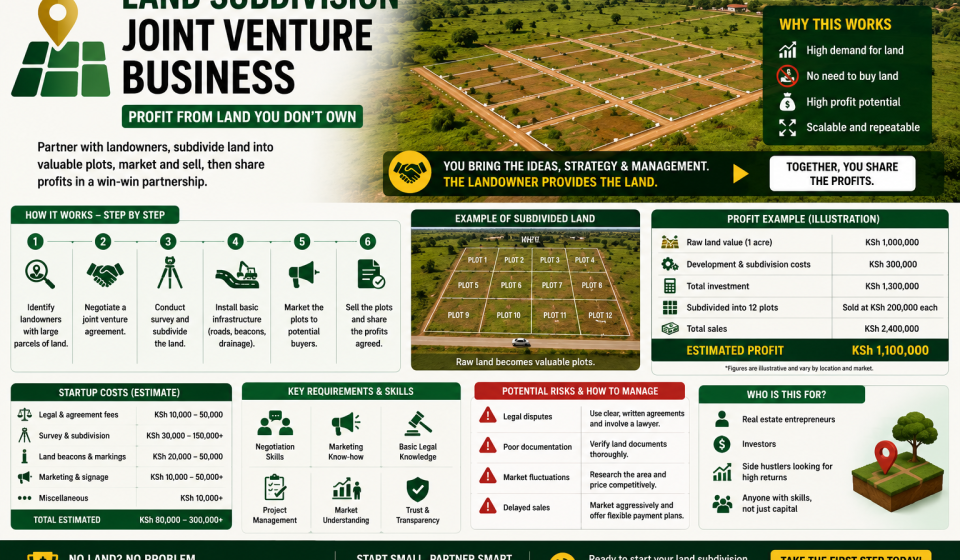
Instead of buying land yourself, you:
- Partner with landowners
- Subdivide their land into smaller plots
- Market and sell those plots
- Share profits after sales
In simple terms:
You help transform raw land into marketable plots.
This is one of the smartest ways to enter real estate with limited capital.
What Is a Land Subdivision Business?
A land subdivision business involves taking a large piece of land and dividing it into smaller plots that can be sold individually.
Example:
- A 5-acre piece of land may become:
- 40 quarter-acre plots
- 80 eighth-acre plots
- or more depending on zoning
Smaller plots are:
- More affordable
- Easier to sell
- More profitable collectively
Why Subdivision Creates So Much Profit
Raw land often has hidden value.
Many landowners:
- Own large idle land parcels
- Lack money to develop or market them
- Cannot access buyers effectively
Subdivision unlocks that value.
Example
| Scenario | Value |
|---|---|
| 5 acres sold as one block | KSh 5 million |
| Same land subdivided into plots | KSh 10–15 million |
That difference creates the business opportunity.
The Joint Venture Model Explained
This is the key concept.
Instead of buying the land:
You partner with the owner.
The Landowner Provides
- The land
- Ownership documents
- Consent for subdivision
You Provide
- Planning
- Survey coordination
- Marketing
- Buyer sourcing
- Sales management
Profits Are Shared
After sales:
- Expenses are deducted
- Remaining profits are split based on agreement
This is called a:
Joint Venture (JV)
Why This Business Works
1. Landowners Want Better Returns
Many landowners:
- Sit on undeveloped land for years
- Lack development expertise
- Need help unlocking value
2. Smaller Plots Sell Faster
Most buyers cannot afford large land blocks.
But many can afford:
- Quarter-acre plots
- Eighth-acre plots
- Small residential plots
Subdivision increases affordability.
3. Urban Expansion Is Growing
As towns and cities expand:
- Demand for affordable plots rises
- Subdivision becomes more attractive
4. Low Capital Entry
Compared to buying land outright:
This model dramatically reduces startup costs.
What You Actually Do in This Business
Your role is to:
- Identify opportunities
- Structure deals
- Coordinate professionals
- Market plots
- Drive sales
You become the:
Organizer and project manager.
Step-by-Step Guide to Starting
Step 1: Learn Your Local Land Market
Before anything:
Understand:
- Which areas are growing
- Which areas attract buyers
- Plot price trends
- Road and infrastructure developments
Look for:
- Expanding towns
- New highways
- Universities
- Industrial zones
- Upcoming developments
Growth creates demand.
Step 2: Identify Suitable Land
Ideal land should:
- Have clean ownership documents
- Be accessible
- Be in a growing area
- Have subdivision potential
Warning Signs
Avoid land with:
- Ownership disputes
- Family conflicts
- Poor access roads
- Environmental restrictions
Legal problems can destroy projects.
Step 3: Approach Landowners Professionally
Many landowners do not know subdivision is an option.
Your job is to explain:
- Increased value potential
- Shared profits
- Structured process
Example Pitch
“Instead of selling your land as one large block, we can subdivide it into smaller plots, market them professionally, and potentially increase the total value significantly.”
Simple.
Clear.
Professional.
Step 4: Structure the Joint Venture Agreement
This is extremely important.
Always involve:
- Lawyers
- Surveyors
- Proper written agreements
The Agreement Should Cover
| Area | Importance |
|---|---|
| Profit sharing | Prevent disputes |
| Responsibilities | Define roles clearly |
| Project timelines | Ensure accountability |
| Cost responsibilities | Clarify expenses |
| Dispute resolution | Protect both parties |
Never rely on verbal agreements.
Step 5: Conduct Land Survey & Planning
Professional surveyors will:
- Measure land
- Design plot layouts
- Create subdivision plans
- Mark roads and access points
Good planning increases plot appeal.
Step 6: Improve Basic Infrastructure
Even small improvements increase buyer confidence.
Examples:
- Access roads
- Beacons
- Signboards
- Basic drainage
Presentation matters.
Visual Placeholder
📌 Insert image: Drone-style view of subdivided plots with access roads and marked boundaries
Step 7: Market the Plots
This is where money is made.
Effective Marketing Methods
1. Social Media Marketing
Use:
- TikTok
- WhatsApp groups
2. Site Visits
Organize:
- Plot viewing days
- Transportation for buyers
- Guided tours
Seeing land physically increases trust.
3. Signboards
Place visible signboards near:
- Roads
- Town centers
- Busy junctions
4. Referral Networks
Use:
- Brokers
- Local agents
- Community referrals
What Buyers Care About Most
Buyers usually ask:
- Is the title clean?
- Is the area growing?
- Is water available?
- Is electricity nearby?
- Are roads accessible?
- Is the process legitimate?
Transparency builds trust.
How Profit Is Made
Example Scenario
| Item | Amount |
|---|---|
| Original land value | KSh 5 million |
| Survey & setup costs | KSh 1 million |
| Total project cost | KSh 6 million |
| Total sales after subdivision | KSh 12 million |
| Gross profit | KSh 6 million |
Profit is then shared based on agreement.
Startup Costs
Compared to traditional real estate, costs are lower.
Typical Expenses
| Expense | Estimated Cost |
|---|---|
| Legal agreements | KSh 20K – 100K |
| Surveying | Variable |
| Marketing | KSh 10K – 100K |
| Site preparation | Variable |
| Transportation | Variable |
Common Challenges
1. Legal Disputes
Solution:
Always verify ownership and documentation.
2. Slow Sales
Solution:
- Better marketing
- Flexible payment plans
- Improve presentation
3. Landowner Conflicts
Solution:
Clear agreements from the beginning.
4. Cash Flow Pressure
Subdivision projects may take months before major sales happen.
Plan finances carefully.
How to Stand Out in This Industry
Most brokers only connect buyers and sellers.
You should focus on:
- Professional project organization
- Transparency
- Proper documentation
- Structured marketing
- Buyer confidence
That creates long-term credibility.
Scaling the Business
Once successful, you can expand into:
- Full real estate development
- Gated communities
- Affordable housing projects
- Land investment groups
- Property management
Why This Business Is Powerful
This business allows you to participate in real estate growth using:
- Strategy
- Partnerships
- Coordination
instead of massive capital.
You create value through:
- Organization
- Planning
- Market understanding
- Sales execution
Final Thoughts
Many people wait years trying to save enough money to buy large amounts of land before entering real estate.
But land subdivision offers another path:
A smarter, partnership-driven model.
It is:
- Practical
- Scalable
- High-profit potential
- Relationship-driven
- Accessible to beginners willing to learn
Most importantly:
It transforms undeveloped land into organized, marketable opportunities that people can actually afford to buy.
That is where the real value is created.